MOUSE SENSITIVITY CONVERTER / TURN COUNT GUIDE
A matching final view does not prove one full mouse turn
When measuring cm/360, count completed revolutions and keep direction under observation. The same final heading can follow one, two or more full turns. For a constant one-direction response, distance per turn = total tracked travel/completed turns. A start and end screenshot alone cannot supply that turn count.
Published October 30, 2026 · AimConvert · an independent developer
Open the sensitivity converter ↗Orientation and accumulated rotation answer different questions
A heading tells you where the view points, not the entire path used to reach it. Unity's angle-difference API illustrates the distinction by returning the shortest angular difference, including an example with angles beyond one revolution. That is useful representation context, not evidence that a specific game's displayed heading records every turn or that a shortest difference is an accumulated motion measurement.
Construct three motions with the same endpoint
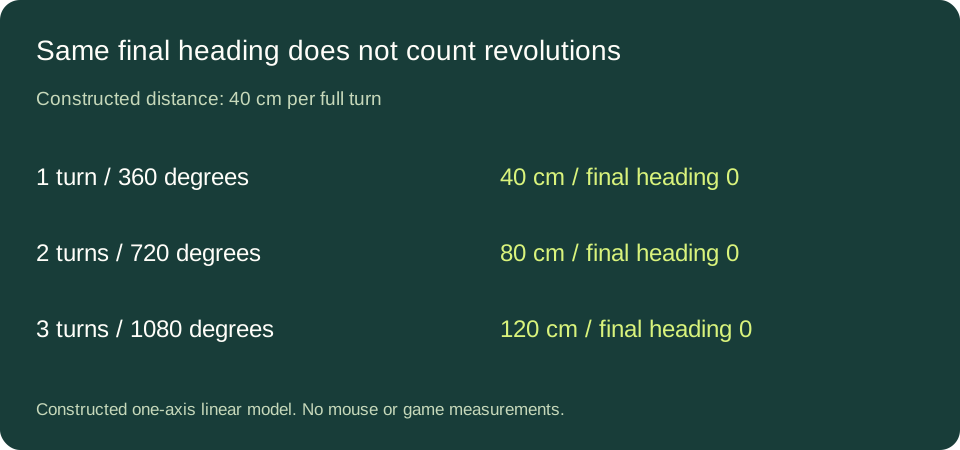
Choose a fictional constant response of forty centimeters for one horizontal full turn. Moving forty centimeters in one direction produces 360 degrees; eighty produces 720; 120 produces 1080. All three end at the original heading when orientation is represented modulo 360 degrees. The required travel differs even though a final still image could show the same direction.
Write accumulated rotation as theta and the displayed heading as theta modulo 360. Adding any integer multiple of 360 leaves that heading unchanged. Losing the integer revolution count is therefore a mathematical ambiguity, not a small decimal-rounding error. These constructed motions do not claim that someone made this mistake in a real measurement or that a game's response is always linear.
Keep the divisor attached to the distance record
Suppose a separate synthetic record contains total straight travel of ninety centimeters and a matching final heading, but no turn count. If it represented one complete turn, the candidate would be ninety centimeters per turn. If it represented two, the candidate would be forty-five; if three, thirty. Those are alternative interpretations of an incomplete record, not three measurements of one setup.
The formula D = L/n requires a positive known revolution count n and a travel L belonging to those revolutions. It cannot recover n from the matching endpoint alone. Keep the observed turn tally and the distance in the same record. If that tally was lost, retain the record as incomplete and repeat the observation instead of choosing the divisor that best matches a calculator.
A reversal introduces another kind of mismatch
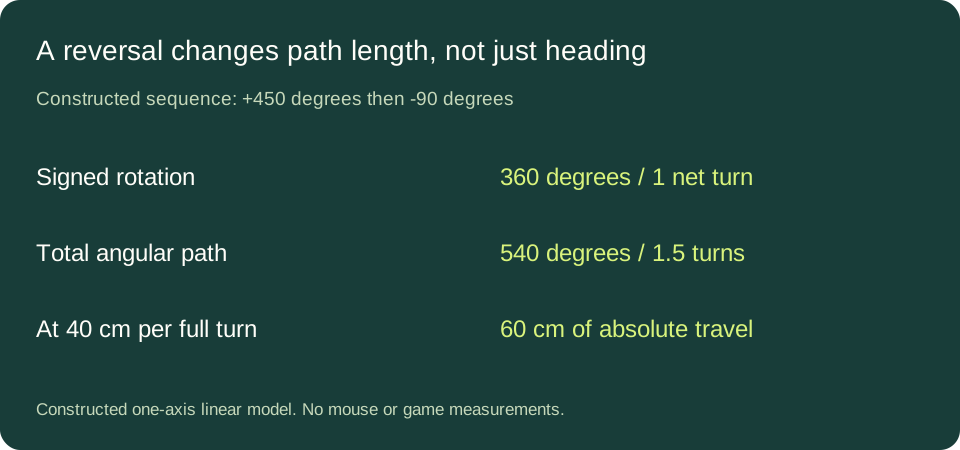
Return to the constructed forty-centimeter full-turn model. Deliberately rotate forward 450 degrees and then back ninety. The signed total is 360 degrees, but the angular path length is 540. Absolute physical travel is therefore 40 × 540/360 = sixty centimeters. The final heading matches the starting heading, yet dividing absolute travel by one net revolution reports sixty rather than the model's forty.
This counterexample isolates direction. Net rotation and total path length are different quantities; a final heading does not identify either one uniquely. A one-direction procedure keeps those quantities aligned under the stated linear model. It is not enough to add the lengths of back-and-forth strokes and label the result a single-turn distance.
A wrapped heading log can also lose turns
Construct two consecutive heading readings of 350 and ten degrees. A forward change of twenty degrees fits them, but so does a forward change of 380 or a backward change of 340. All three produce the same wrapped endpoint. Choosing the shortest difference picks twenty; it does not establish which motion actually occurred between the readings.
A signed shortest-difference accumulation needs a separately justified bound on motion between samples, such as an actual magnitude strictly below 180 degrees for each interval. Without that condition, wrapping can hide whole revolutions or reverse the inferred direction. This is a conditional mathematical requirement, not a claim that a particular capture frame rate or game log always satisfies it. Inspect the observation method before calling its total unwrapped.
Use a record that preserves the motion
- Record the retained game setting, aim mode, active DPI profile and measurement procedure.
- Choose a unique heading landmark and a direction; observe the motion continuously so completed revolutions can be counted.
- Pair the tracked physical travel with the known turn tally. If lifting or repositioning is necessary, keep those segments explicit and do not assume they preserve the same input response.
- Retain the turn tally, direction and raw distances. If the path or count is uncertain, repeat instead of inferring it from the endpoint.
Use the separate distance-record guide for ruler and endpoint precision. This guide addresses missing revolution information, not a complete uncertainty budget.
Direct answers
Can I verify one turn with only before-and-after images?
No. Matching headings do not distinguish integer multiples of a full revolution.
Can I measure several turns and divide?
Under the stated constant one-direction model, yes, if the full travel and completed-turn count are known and belong together. That does not automatically remove systematic measurement error.
Does this explain every calculator discrepancy?
No. The examples show specific ambiguities, not a diagnosis of a real device or game.
Sources and method
Unity's shortest-angle difference documentation supplies representation context. The full-turn families, incomplete-record cases, reversal example and wrapped-log alternatives here were independently calculated with selected synthetic inputs. No physical observations or current game behavior are reported.