MOUSE SENSITIVITY CONVERTER / ERROR PROPAGATION
Close turn counts amplify distance errors in a two-point slope
For a two-point cm/360 estimate D = (L2 − L1)/(n2 − n1), distance-reading errors are divided by the turn-count separation. With exact counts and each total within a selected bound e, the slope error is at most 2e/|n2 − n1|. That conditional bound is not a measured accuracy or a confidence interval.
Published November 1, 2026 · AimConvert · an independent developer
Open the sensitivity converter ↗The denominator matters after a shared offset cancels
The shared-offset guide explains when subtracting two total distances removes an identical additive offset. This page asks a separate question: how much can imperfect distance readings move that difference-based result? Assume a constant response, known exact revolution counts and a shared fixed offset. Those conditions exclude a lost turn tally, changing game response and an unverified distance scale.
Give every total an explicit error allowance
Construct a response of forty centimeters per turn and a fixed two-centimeter record offset. The selected exact totals at one, two, three and five turns are forty-two, eighty-two, 122 and 202 centimeters. Now assign each recorded total an error between minus 0.2 and plus 0.2 centimeters. That allowance is chosen for arithmetic; it is not a claim about a real ruler, person or mouse.
Compare counts one and two. The most positive difference error occurs when the second reading is 0.2 high and the first is 0.2 low. The distance difference grows by 0.4 centimeters, giving 40.4 instead of forty. Reversing those two signs gives 39.6. Opposite errors are possible under the stated bounds, even though no probability of either combination has been specified.
Separate the counts while retaining the same allowance
Compare one and three turns instead. The same worst-case 0.4-centimeter difference error is divided by two, producing a slope allowance of 0.2 centimeters per turn. Using one and five divides it by four, producing 0.1. The corresponding constructed ranges are 39.8 to 40.2 and 39.9 to 40.1. Every result refers to the same selected per-record bound and an unchanged response.
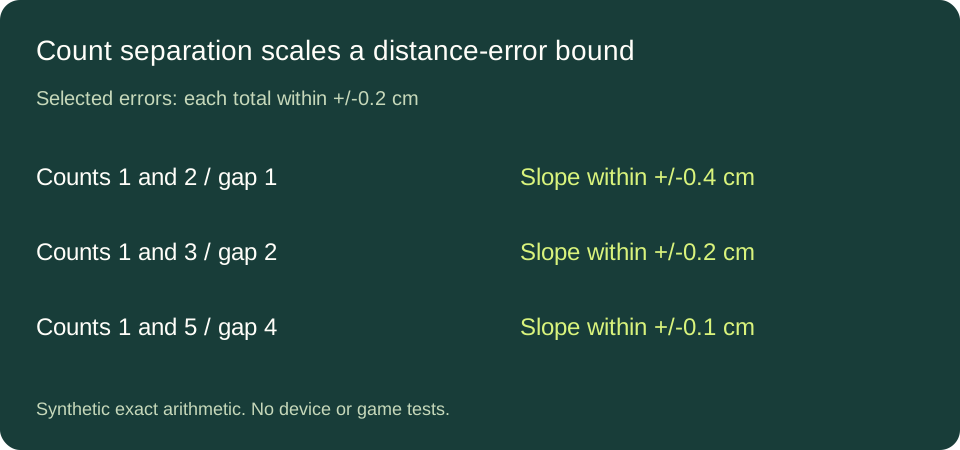
Write recorded totals as L1 plus delta1 and L2 plus delta2. Subtracting the exact slope leaves (delta2 minus delta1)/(n2 minus n1). The triangle inequality bounds its magnitude by (|delta2| + |delta1|)/|n2 minus n1|. If both are at most e, the result is 2e divided by the absolute count separation. Unequal bounds e1 and e2 instead give (e1 + e2)/|n2 minus n1|.
A longer record can have a larger allowance
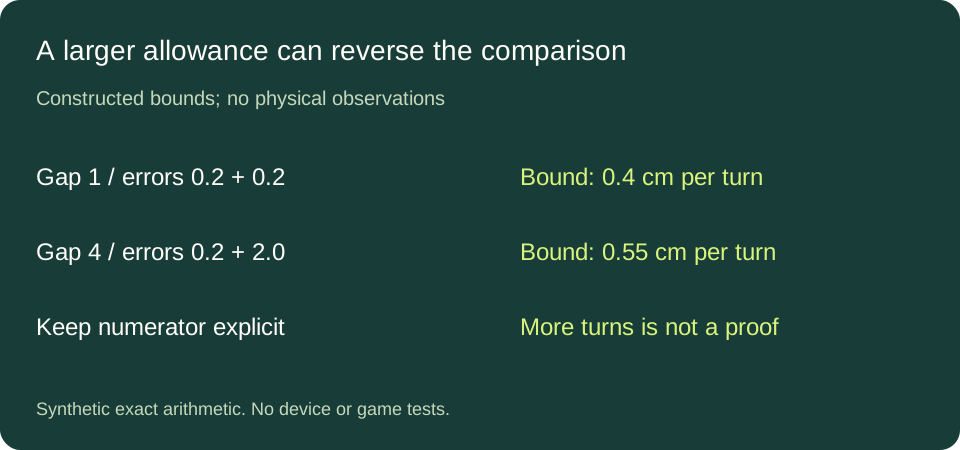
The improvement above held the per-record allowance constant. Change that assumption: keep the one-turn allowance at 0.2 centimeters, but select a five-turn allowance of two centimeters. The difference-based slope bound becomes (0.2 + 2)/4 = 0.55 centimeters per turn. This is larger than the earlier one-versus-two bound of 0.4. More separated counts did not compensate for the newly selected larger error allowance.
This counterexample does not assert that longer mouse travel necessarily has that error. It shows why the denominator alone cannot rank two procedures when the numerator assumptions change. Lifting, repositioning or losing track of motion requires an explicit method assessment; it cannot be represented by a smaller bound merely because the record contains more revolutions.
Shared errors and opposite errors behave differently
For any fixed count pair, equal signed reading errors cancel from the difference. Opposite signed errors add in magnitude. The worst-case bound deliberately covers both without asserting a distribution. Repeating the same number in a table does not establish which pattern real observations follow, nor does it establish independence.
If a separate statistical model supplies equal standard uncertainties u and zero covariance for the two total estimates, its slope standard uncertainty is sqrt(2)u/|n2 minus n1|. Selecting u = 0.2 and separation two gives approximately 0.141421 centimeters per turn. That is a different input interpretation from a hard bound of 0.2, so it is not a substitute for the earlier 0.2 worst-case slope allowance. With covariance c retained, the numerator becomes sqrt(u1 squared + u2 squared − 2c). Unknown covariance must not silently be set to zero.
What to retain before comparing against a converter
- Record the raw total distances, their paired completed-turn counts, direction, setup and procedure.
- State whether each allowance is a hard bound, a standard uncertainty or simply an unverified guess. A ruler tick by itself does not establish a complete allowance.
- Keep the assumptions for scale, shared offset and response separate. This slope calculation only addresses the specified distance errors with exact counts.
- Use repeated observations to investigate the method. Do not report these synthetic limits as observed device performance or use extra decimal places as evidence of accuracy.
Direct answers
Should I always use the largest possible turn count?
No. Wider separation helps the stated formula only relative to the distance-error allowances and unchanged model conditions.
Is a calculated bound a ninety-five percent confidence interval?
No. The bound here has no probability model or claimed coverage percentage.
Does subtraction cancel all measurement uncertainty?
No. It can cancel a shared additive offset while other distance errors, scale effects and model failures remain.
Sources and method
NIST TN 1297, Appendix A provides general context for sensitivity coefficients and covariance in uncertainty propagation. The bounded-error algebra, selected totals, count-pair comparisons and changing-allowance example were independently calculated here. No current-game behavior or physical measurement results are reported.