MOUSE SENSITIVITY CONVERTER / MEASUREMENT MODEL
Repeated turns do not automatically remove a distance offset
Dividing a longer travel by its turn count reduces a fixed start/end offset per turn, but does not remove it. Under the explicit model L(n) = nD + b, the ratio is D + b/n. Differences between two records cancel b only if that same offset and the same response apply to both.
Published October 31, 2026 · AimConvert · an independent developer
Open the sensitivity converter ↗Separate the response from the recording procedure
Here D means the physical distance for a full turn under a chosen constant response; n is a known completed-turn count; L is the recorded total distance. The added term b represents a hypothetical offset shared by whole records, not an observed fault in your mouse. NIST's calibration guidance includes both intercept and slope and warns against simply discarding the intercept. That general modeling principle motivates this exercise; it does not certify a mouse test or supply its coefficients.
Build a record with a two-centimeter offset
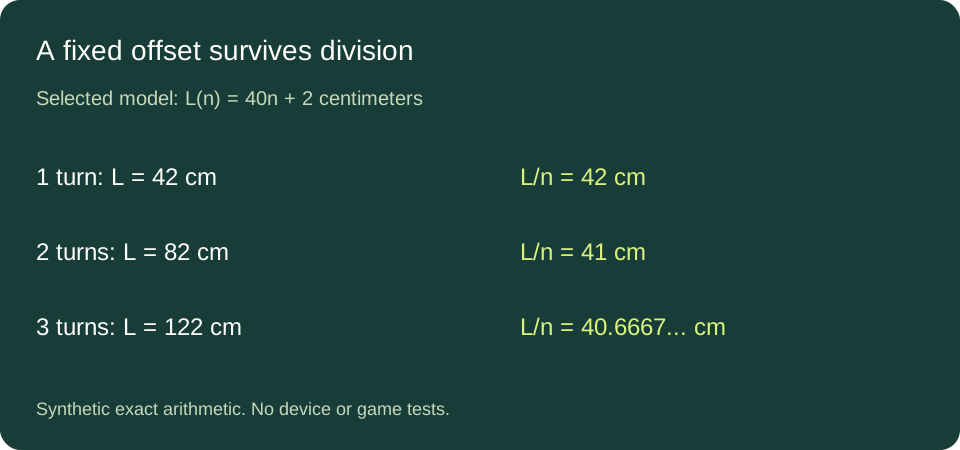
Select D = forty centimeters per turn and b = two centimeters per record. The constructed totals for one, two and three turns are forty-two, eighty-two and 122 centimeters. Dividing each by its own known count gives forty-two, forty-one and forty and two thirds centimeters per turn. Increasing the count gets the ratio closer to the selected forty, while every finite ratio remains above it.
Algebra exposes why: L/n = (nD + b)/n = D + b/n. Five turns produce 202 centimeters and a ratio of 40.4. The offset contribution falls from two centimeters per turn to 0.4; it does not become zero. These are exact model outputs rather than repeated physical trials, so their smooth progression cannot demonstrate the precision of any real measuring technique.
Taking more averages is a different operation
A simple average of the first three ratios is (42 + 41 + 122/3)/3 = 371/9, approximately 41.2222 centimeters per turn. It remains above forty. Repeating the identical constructed one-turn record would still give forty-two every time. More repetitions of an offset record do not cancel its shared offset merely because the results are averaged.
Pooling those three totals and dividing by their combined six turns gives 246/6 = forty-one. That is a different weighting from averaging the three ratios, and it also retains bias in this selected model: each of the three records contributed its own two-centimeter offset. Do not concatenate record totals and silently treat their three offsets as a single offset. Retain record boundaries alongside counts.
Use a difference to isolate the conditional slope
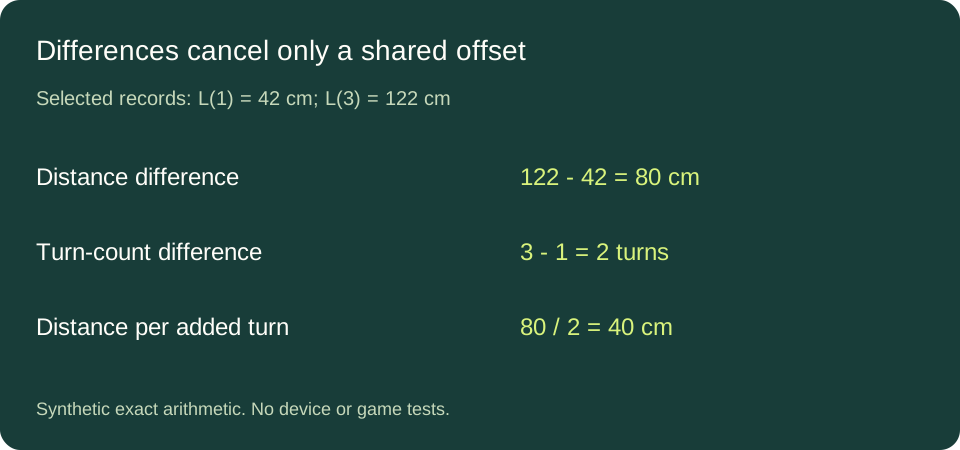
Subtract the one-turn total from the three-turn total: 122 minus forty-two equals eighty centimeters. The count difference is two, so the constructed distance per additional turn is eighty divided by two, or forty. Substituting back gives b = 42 minus forty times one = two centimeters. Both selected coefficients are recovered here because the data were made from that exact model.
In symbols, L(n2) minus L(n1) equals (n2 minus n1)D when both records share b. Divide by the nonzero count difference to recover D. This is a two-point slope, not a statistical demonstration of linearity or a complete uncertainty estimate. Real noisy observations require more evidence than two values that can always define a line.
Break the assumption and the answer changes
Keep the selected response at forty, but make the one-turn offset two and the three-turn offset six. Totals are then forty-two and 126. Their difference divided by two is forty-two, not forty. An offset that changes with count is not removed by the shared-offset subtraction. This constructed counterexample is why a difference result cannot itself prove that endpoint effects were stable.
A scale error also survives. If a fictional distance scale reports 1.05 times actual travel plus two, totals follow L = 42n + 2 even though selected actual distance remains forty per turn. Subtraction recovers forty-two in the scale's reported units. Removing an additive intercept does not independently validate the ruler scale or constant input response. Neither this example nor the changing-offset case diagnoses an actual reader's setup.
Keep useful records without overstating the result
- Keep the same input mode, DPI and game setting, and record the actual count and direction. The turn-count guide explains why endpoints alone do not supply the count.
- Retain separate raw totals and their procedure. Do not assume every lift, repositioning or endpoint shares one offset.
- Compare several counts and repeated records before interpreting a slope. Check whether a simple line is even a plausible description.
- Report assumptions and measurement resolution alongside results. Use the measurement record guide; these calculations do not replace an uncertainty budget.
Direct answers
Does measuring five turns remove an endpoint offset?
Not in the stated model. The per-turn contribution becomes b/5 and remains unless b is zero.
Should I subtract two measurements to correct my converter?
Not automatically. The cancellation requires a shared offset and response, and does not validate the measuring scale.
Are these real mouse measurements?
No. All distances are selected synthetic examples for testing the model and its limits.
Sources and method
NIST: models for instrument calibration supplies general intercept/slope context. All coefficients, totals, averaging comparisons and assumption-breaking cases were independently selected and calculated here. They are not fitted device data or a current-game claim.