MOUSE SENSITIVITY CONVERTER / QUANTITY GUIDE
cm/360 and degrees/cm: read the reciprocal correctly
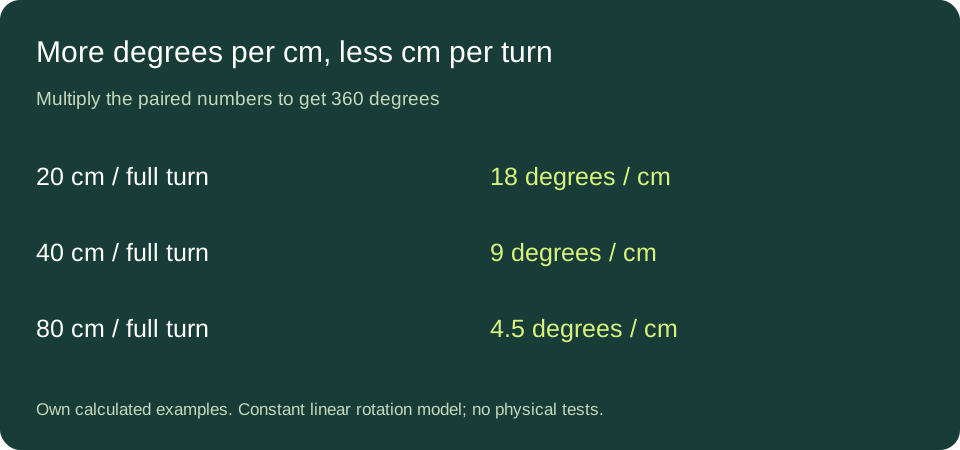
For constant horizontal rotation, degrees per centimeter = 360 ÷ cm/360, and cm/360 = 360 ÷ degrees per centimeter. A 40 cm full turn is 9 degrees/cm. Larger degrees/cm means less travel per turn; larger cm/360 means more travel. Keep the quantity label with every number.
Published October 22, 2026 · AimConvert · an independent developer
Convert a full-turn distance ↗Read the numerator and denominator
cm/360 is conventional shorthand for centimeters of mouse travel per full 360-degree turn. Degrees/cm describes angular rotation for each centimeter. These quantities run in opposite directions. They are different from DPI, which describes mouse counts per inch, and from a game's menu setting. The formulas here assume a fixed linear relationship between travel and horizontal rotation, not acceleration or a varying scoped multiplier.
Build a table from the same full turn
Choose five full-turn distances and divide 360 degrees by each distance. These are author-selected inputs, not measurements or preferred settings. The last column multiplies the distance by its angular response. In every row, centimeters cancel and the product is a complete 360-degree turn. This provides a simple dimensional check rather than relying on a familiar-looking numeral.
| cm per full turn | Degrees per cm | Product check |
|---|---|---|
| 20 | 18 | 360° |
| 30 | 12 | 360° |
| 40 | 9 | 360° |
| 60 | 6 | 360° |
| 80 | 4.5 | 360° |
For forty centimeters, 360/40 = nine degrees per centimeter. At that response, five centimeters produces 5 × 9 = 45 degrees. Twenty centimeters produces 180 degrees. Reversing the calculation, 360/9 returns forty centimeters. The intermediate movements follow from the assumed constant response; they are not a test showing that a real setup is linear.
Do not invert the number without the angle scale
The bare reciprocal of forty is 0.025. If forty was centimeters per turn, that reciprocal is turns per centimeter. To express the answer in degrees per centimeter, multiply by 360 degrees per turn: 0.025 × 360 = nine. Writing 0.025 degrees/cm would miss the turn-to-degree factor and describe a different response.
A second label trap is to copy a value of nine degrees/cm into a cm/360 input. The correct distance is 360/9 = forty centimeters. A request for nine cm per turn instead implies 360/9 = forty degrees/cm. The numerals have exchanged roles. Under fixed DPI and coefficient, that mistaken distance requests a sensitivity factor of 40/9, approximately 4.4444, relative to the forty-centimeter target. This is a constructed input error, not a diagnosis of any particular converter.
Percentage changes are reciprocal too
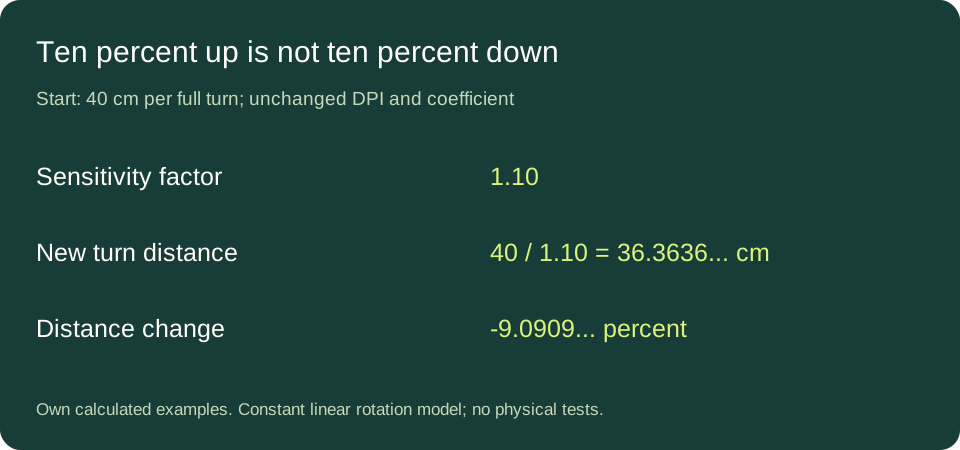
Start with forty cm per turn and multiply sensitivity by 1.10 while keeping DPI and the linear coefficient fixed. Angular response rises from nine to 9.9 degrees/cm. The new full-turn distance is 360/9.9 = 400/11, approximately 36.3636 cm. Its change relative to forty is (1/1.10 − 1) × 100, approximately −9.0909 percent, rather than minus ten percent.
Distance change (%) = (1 ÷ sensitivity factor − 1) × 100
| Sensitivity factor | New cm/360 | Distance change |
|---|---|---|
| 0.8 | 50.0000 | +25.0000% |
| 0.9 | 44.4444 | +11.1111% |
| 1 | 40.0000 | +0.0000% |
| 1.1 | 36.3636 | -9.0909% |
| 1.25 | 32.0000 | -20.0000% |
| 2 | 20.0000 | -50.0000% |
A factor of 0.8 lowers sensitivity by twenty percent, but forty divided by 0.8 is fifty centimeters: travel rises by twenty-five percent. A factor of 1.25 raises sensitivity by twenty-five percent, but the distance becomes thirty-two centimeters: travel falls by twenty percent. The paired changes reverse one another because the multiplicative factors, 0.8 and 1.25, multiply to one. Adding or subtracting the same percentage in both quantities would not preserve this relationship.
Connect degrees/cm to the converter model
Take a disclosed model with DPI 800 and yaw 0.07 degrees per count at sensitivity one. For nine degrees/cm, multiply by 2.54 cm/inch to obtain 22.86 degrees/inch. Divide by 800 counts/inch and by 0.07 degrees/count to obtain sensitivity 1143/2800, approximately 0.408214285714. The length, count and angle units cancel.
Check using distance instead: 914.4/(800 × 0.07 × 40) gives the same fraction. The factor 914.4 is 360 × 2.54. These two routes connect the quantities without treating nine degrees/cm as a menu setting. They establish consistency of the stated model, not current-build accuracy of a game coefficient or measured mouse DPI.
Use the correct input field
AimConvert accepts sensitivity, cm/360 or inches/360. It does not accept degrees/cm directly. Convert a positive degrees/cm value to a full-turn distance first, select cm / 360°, then enter that distance. Keep the target DPI and supported preset fixed when checking the worked example. For length-only changes, see inches/360 versus cm/360.
Direct answers
Does higher cm/360 mean more rotation per centimeter?
No. With constant response, it means less rotation per centimeter and more travel for a complete turn.
Can zero degrees/cm be converted to a finite full-turn distance?
No. Division by zero is undefined; zero angular response cannot complete a turn over a finite distance in this model.
Does this predict visual feel or aiming improvement?
No. The calculation concerns physical travel and horizontal angle only. It makes no claim about field of view, player performance or preferred settings.
Sources and method
NIST's angle and length conversion table supplies unit context. Reciprocal equations and percentage counterexamples were derived and checked with exact rational arithmetic from the inputs disclosed above. No physical game or mouse tests were performed.