MOUSE SENSITIVITY CONVERTER / SPACE GUIDE
How much turn fits in your usable mouse space?
With constant horizontal rotation, available turn angle = 360 × remaining mouse travel ÷ cm/360. Measure travel from your current position in the direction you need, not the pad's advertised width. At 40 cm/360, 20 cm of remaining travel permits 180° in this model; 18 cm permits 162°.
Published October 23, 2026 · AimConvert · an independent developer
Find your modeled cm/360 ↗Define a usable interval first
Use a straight horizontal interval of sensor positions that you can reach while keeping the mouse supported and avoiding obstructions. Its endpoints are positions of the same reference point, not the outside edges of the mat. Keyboard overlap, edge clearance, the mouse footprint and comfortable reach can limit this interval. Record the chosen boundaries instead of automatically subtracting an assumed universal margin from a product width.
This guide concerns uninterrupted motion with unchanged mouse orientation and a constant horizontal response. It is not a prediction of hand comfort, a shopping rule or a claim that every game movement follows the model. Lifting and repositioning the mouse starts a new movement budget.
One interval, three different starts
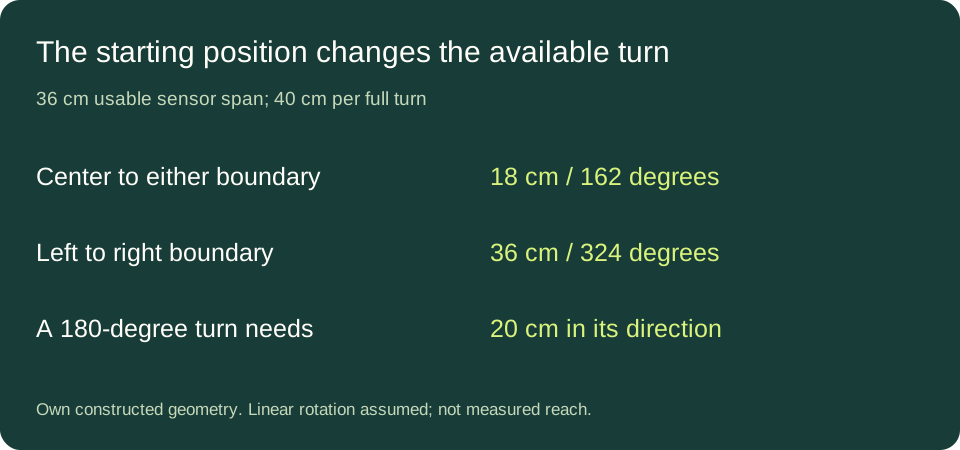
Construct a usable sensor-position interval from zero to 36 cm and choose 40 cm per full turn. These are invented dimensions for an exact geometry example, not measurements of a product or a player's reach. If the current position is x centimeters from the left boundary, leftward travel is x and rightward travel is 36 minus x.
Right turn budget = 360 × (36 − x) / 40
| Start | Left travel cm | Right travel cm | Left / right turn |
|---|---|---|---|
| Centered | 18 | 18 | 162° / 162° |
| Shifted left | 10 | 26 | 90° / 234° |
| At left boundary | 0 | 36 | 0° / 324° |
Starting at the midpoint gives eighteen centimeters each way. Multiplying eighteen by nine degrees per centimeter gives 162 degrees. Moving across the entire usable span instead gives 36 × 9 = 324 degrees. Both calculations use the same sensitivity and the same interval; only the starting position differs. Using the full span to describe what is available from the midpoint would double the directional budget incorrectly.
Can a 180-degree turn fit in both directions?
At forty centimeters per turn, a half turn needs twenty centimeters. In the constructed 36 cm interval, a start at ten centimeters leaves twenty-six to the right, so a rightward half turn fits geometrically and leaves six centimeters. The leftward budget is only ten centimeters, corresponding to ninety degrees. A statement that the setup can perform a half turn therefore needs a direction and a starting position.
To allow a half turn either left or right from the same start, both x and W minus x must be at least D/2, where W is usable span and D is full-turn distance. Adding the inequalities requires W to be at least D. If W equals forty and D equals forty, only the midpoint gives twenty centimeters each way. This equality leaves no spare travel in the idealized model, so it should not be presented as a comfort recommendation or an allowance for uncertainty.
A first turn can consume the next turn's space
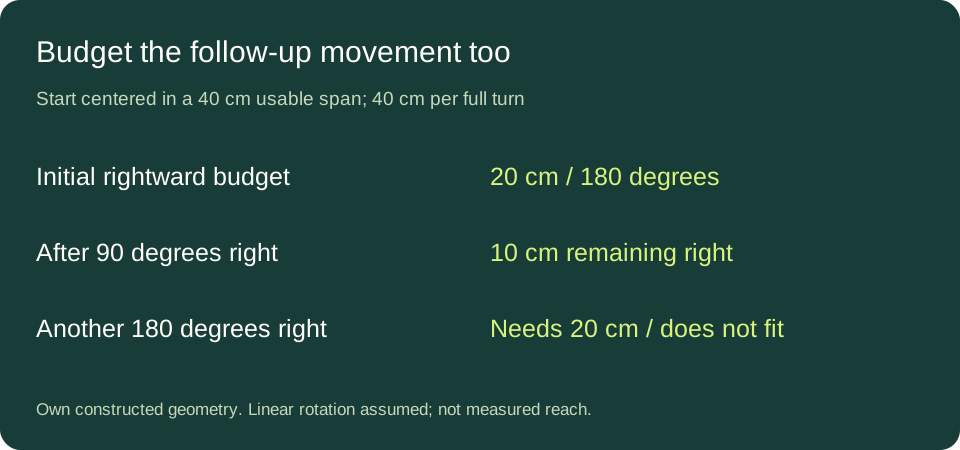
Construct a second interval, zero to forty centimeters, again at forty cm/360. Begin at twenty centimeters. A ninety-degree right turn uses ten centimeters and moves the sensor position to thirty. Now only ten centimeters remain to the right. A further 180-degree right turn would require twenty centimeters, so it cannot fit without changing the assumed movement plan.
The combined same-direction rotation is 270 degrees, requiring 40 × 270/360 = thirty centimeters of travel. The original rightward budget was only twenty. Counting each turn independently from a centered start would overlook this accumulated movement. A reposition between turns would change the premise and must be recorded explicitly, rather than silently resetting the coordinate in the calculation.
Solve for distance without claiming an optimal setting
Suppose a constructed directional budget is eighteen centimeters and a planned angle is 180 degrees. Rearranging angle = 360 × travel/D gives D = 360 × 18/180 = thirty-six cm/360 at exact equality. A forty cm/360 setting would require twenty centimeters for that angle, exceeding the budget by two centimeters. The equality identifies a geometric boundary under the assumptions, not an optimal sensitivity.
If the planned angle changes to ninety degrees while the eighteen-centimeter budget remains fixed, the equality becomes seventy-two cm/360. The result changes because the task changed, even though the available space did not. Neither number establishes what a person should use. Compare the calculated requirement with independently observed setup limits before drawing a practical conclusion.
Keep a directional record
Record the full-turn distance and how it was obtained, the usable sensor-position endpoints, your start position, the intended direction and angle, and whether repositioning is allowed. Keep length units consistent. If cm/360 came from a preset, label it a model output until physically checked; see the measurement record guide.
Direct answers
Does a pad wider than half my cm/360 guarantee a centered 180?
No. Half the full-turn distance is required directional travel. From a centered start, only half the usable interval lies in either direction.
Can I use the diagonal instead of horizontal width?
Not in this one-dimensional model. A diagonal path has different horizontal and vertical components; its total length is not automatically horizontal rotation input.
Does failing the space calculation mean the converter is wrong?
No. It can mean the planned travel exceeds the defined interval. Verify the setup and assumptions separately; this geometry does not test a game's coefficient.
Sources and method
KovaaK's converter documentation defines cm/360 as full-turn mouse travel. The directional interval and sequential examples here are independently derived and checked with exact rational arithmetic. No product dimensions, physical reach measurements or performance results are claimed.