MOUSE SENSITIVITY CONVERTER / FEASIBILITY GUIDE
Can your target cm/360 fit a sensitivity step?
Calculate the ideal sensitivity, then check the allowed retained settings immediately below and above it. Convert both back to cm/360 and compare their distance errors. A continuous converter result may be impossible to retain on a discrete slider; rounding the sensitivity numeral alone does not always minimize distance error.
Published October 24, 2026 · AimConvert · an independent developer
Calculate a target-distance setting ↗Identify the retained grid, not just the display
Record the setting values the game actually saves, including the step, lower and upper limits, and any offset. Do not assume a two-decimal display proves a 0.01 retained step. A text field, slider and saved configuration can have different behavior. This guide uses deliberately fictional grids so it does not attribute an unverified restriction to a current game.
Keep DPI, aim mode and the linear coefficient fixed while testing candidates. If the model is distance = K / sensitivity, K includes those fixed quantities. Changing DPI during the comparison creates a different candidate problem.
A target between two allowed settings
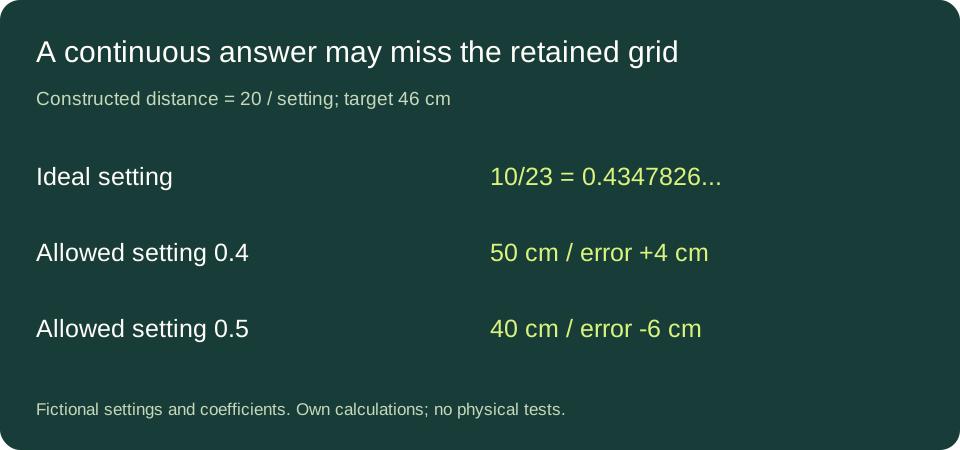
Construct a model D = 20/s, where D is the numerical full-turn distance in centimeters and s is a positive sensitivity setting. Choose a target of 46 cm. The ideal continuous setting is 20/46 = 10/23, approximately 0.4347826087. Now suppose only positive multiples of 0.1 are retained. This grid is an author-chosen constraint, not a tested game slider.
| Retained setting | cm/360 | Distance minus 46 cm |
|---|---|---|
| 0.3 | 66.6667 | +20.6667 |
| 0.4 | 50.0000 | +4.0000 |
| 0.5 | 40.0000 | -6.0000 |
| 0.6 | 33.3333 | -12.6667 |
The bracketing settings are 0.4 and 0.5. Their distances are exactly fifty and forty centimeters. Absolute errors are four and six centimeters, so 0.4 is the closer distance for this constructed target. Printing more digits of 10/23 does not put it on the assumed grid: dividing the ideal setting by the step gives 100/23, which is not an integer.
Why only the two neighbors matter here
For positive s and K, distance K/s strictly decreases as s increases. Any allowed setting below 0.4 produces at least fifty centimeters, so it cannot have a smaller absolute difference from forty-six than 0.4. Any allowed setting above 0.5 produces at most forty centimeters and cannot improve on 0.5. Thus the two bracketing values suffice for minimum absolute distance error in this specific monotonic model.
If the ideal value lies outside the retained range, there may be only a boundary candidate instead of a pair. If the actual game response is nonlinear or not monotonic, the two-neighbor argument needs a separate justification. The proof is conditional on the disclosed model, not a promise about every sensitivity control.
A counterexample to rounding the sensitivity numeral
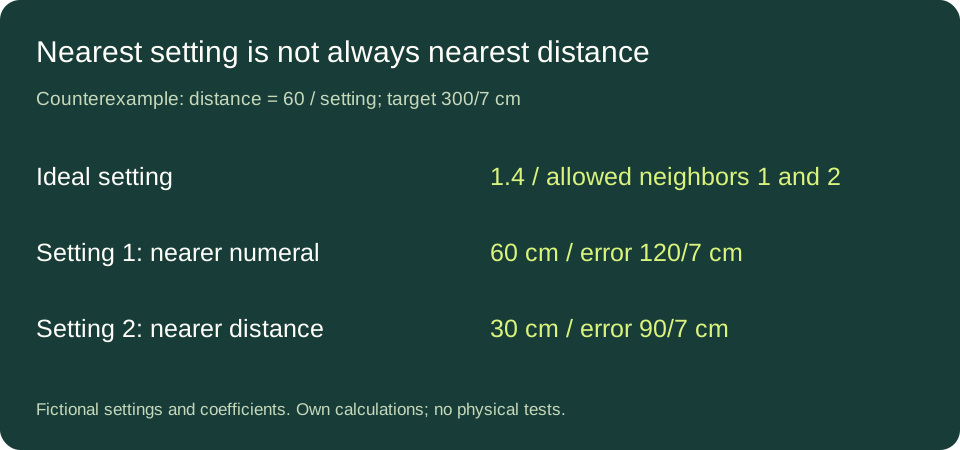
Construct a different model, D = 60/s, with integer retained settings and a target of 300/7 cm, approximately 42.8571. Its ideal setting is exactly 1.4. The numeral 1 is closer to 1.4 than 2 is: the differences are 0.4 and 0.6. Ordinary nearest-setting rounding therefore picks one.
But setting one gives sixty centimeters, whose absolute distance error is 60 − 300/7 = 120/7 cm, approximately 17.1429. Setting two gives thirty centimeters, whose error is 300/7 − 30 = 90/7 cm, approximately 12.8571. Two is the closer distance, despite being the farther sensitivity numeral. This explicitly separates two optimization objectives; neither result is a player recommendation.
The distance tie is not the setting midpoint
For neighboring positive settings a and b, the distances are K/a and K/b. Equal absolute distance errors occur at target distance (K/a + K/b)/2. Substituting that target into the inverse formula gives ideal setting 2ab/(a+b). This is the harmonic mean of the settings, rather than their arithmetic midpoint.
With a = one and b = two, the distance-error tie occurs at ideal setting 4/3, approximately 1.3333. The nearest-setting tie is at 1.5. Our chosen 1.4 lies between these boundaries, which explains the disagreement without relying on decimal rounding artifacts. Exact rational calculations preserve the separation between the two thresholds.
State an error tolerance before calling it a match
Return to the 46 cm target and 0.1 grid. If the declared tolerance is three centimeters of absolute modeled distance error, neither neighbor passes: four and six both exceed three. If the tolerance is five centimeters, 0.4 passes while 0.5 does not. These tolerances are chosen examples, not recommended acceptable errors or probabilities.
The signed error distinguishes direction: positive four means longer travel than requested; negative six means shorter travel. Preserve that sign in the record even when using absolute error for selection. A closest available value can still fail the declared tolerance, so record both conclusions rather than calling every nearest neighbor an exact match.
Practical record
Keep the desired cm/360, model inputs, ideal setting, actual retained candidates, reconstructed distances, signed errors and chosen tolerance. After applying a candidate, read the setting back and test the assumptions separately. The decimal precision guide addresses copied-number rounding; this page addresses whether a requested distance is representable on an allowed grid.
Direct answers
Can more converter decimals bypass a slider step?
No. A more detailed ideal value does not add allowed retained settings.
Does the nearest cm/360 prove the game matches the model?
No. It minimizes a model-based difference among candidates. Independent observations are still needed to assess real behavior.
Can I optimize DPI and sensitivity together?
That requires the actual allowed values and ranges for both quantities. The examples here hold DPI fixed; they do not claim to search a device's available DPI settings.
Method
All examples use fictional linear coefficients and retained grids. Exact fractions initialized from decimal strings were evaluated using Python's rational arithmetic support. Decimal displays are rounded for reading; comparisons used exact values. No game controls or mouse hardware were physically tested.