MOUSE SENSITIVITY CONVERTER / DISTANCE RATIO GUIDE
Adjust sensitivity from current and desired turn distance
For the same setup with constant linear rotation, new sensitivity = current sensitivity × current cm/360 ÷ desired cm/360. Keep DPI, aim mode and all other response multipliers unchanged. Calculate a candidate, apply the setting the game actually retains, then measure again; the ratio cannot validate its own assumptions.
Published October 25, 2026 · AimConvert · an independent developer
Open the sensitivity converter ↗Keep the baseline attached to its setting
Record the actual retained sensitivity and the full-turn distance obtained at that sensitivity. Label whether the distance is observed or calculated. Do not pair a new setting with an old measurement. Keep the game, build, aim mode, active DPI profile, input path and relevant multipliers unchanged during the comparison. This is a same-setup adjustment, not a cross-game conversion.
Derive the ratio from one unchanged model
Write the numerical distance model as D = K/s, where s is a positive sensitivity and K contains the unchanged response factors. At the original setting, K = current distance × current sensitivity. Requiring the desired distance at a new setting gives new sensitivity = K/desired distance. Substitution produces the ratio in the first answer.
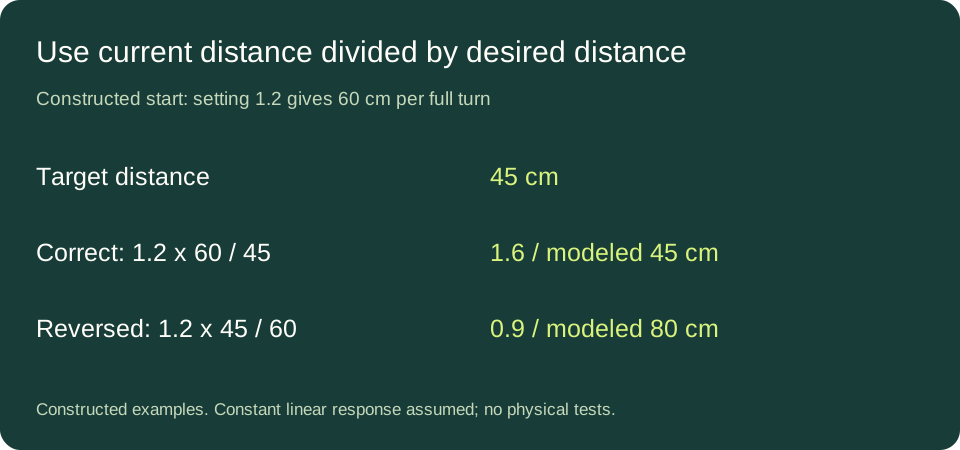
Construct a baseline of sensitivity 1.2 and distance sixty centimeters per turn. Their product is seventy-two. Choose a desired distance of forty-five centimeters. The candidate is 1.2 × 60/45 = 1.6. Checking against the same constructed model gives 72/1.6 = forty-five centimeters. These values are author-selected arithmetic examples, not mouse or game measurements and not a preferred sensitivity.
Candidate sensitivity = 72/45 = 1.6
Model check = 72/1.6 = 45 cm/360
Check the direction before copying the number
The requested distance shrinks from sixty to forty-five, so a linear same-setup model requires sensitivity to increase. Reversing the distance ratio gives 1.2 × 45/60 = 0.9. The resulting modeled distance is 72/0.9 = eighty centimeters, moving away from the chosen target. A directional check catches this particular inversion before any real setting is changed.
The correct sensitivity factor is 60/45 = 4/3, approximately 1.333333. Its increase is one third of the original setting. The distance factor is 45/60 = 3/4, a twenty-five percent decrease. The two multiplicative factors are reciprocal; their percentage changes have different magnitudes. This describes the constructed response, not how the setting will feel visually or affect aiming performance.
Input variation carries into the candidate
Now deliberately invent three possible baseline readings: fifty-eight, sixty and sixty-two centimeters, all attached to setting 1.2. Keeping the desired distance at forty-five gives candidate settings 116/75, 8/5 and 124/75, approximately 1.546667, 1.600000 and 1.653333. These are synthetic inputs used to expose the arithmetic, not repeated trials performed here.
The candidate difference between the two extremes is 8/75, approximately 0.106667. Relative to the center candidate 1.6, the extremes are lower and higher by one thirtieth, about 3.333333 percent. The relative variation matches the constructed baseline variation because the candidate is proportional to the baseline distance while all other inputs remain fixed. This range is not a confidence interval or a complete uncertainty budget.
Use a second setting as an assumption check
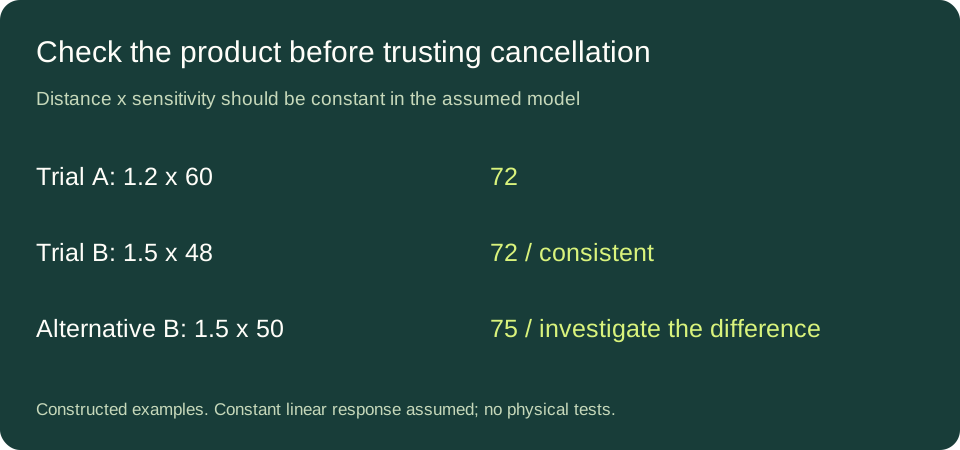
Construct a second trial at sensitivity 1.5 with distance forty-eight centimeters. Its product is 1.5 × 48 = seventy-two, matching the baseline product. This is consistent with a shared K in the selected model. It does not prove the model holds at every setting, or reveal an identical systematic measurement bias in both readings.
As a contrasting synthetic observation, let the second distance be fifty centimeters instead. Its product is seventy-five. The relative product difference is (75/72 − 1) × 100, approximately 4.166667 percent. That discrepancy should prompt checking the records, retained settings, measurement variation and response assumptions. It is not enough to diagnose acceleration, DPI error or any one specific cause.
What if another response factor changes?
Keep the candidate 1.6, but deliberately change K from seventy-two to ninety after the baseline. The resulting distance is 90/1.6 = 56.25 centimeters, not forty-five. The candidate's algebra was correct for the old K; it simply no longer describes the constructed changed setup. This counterexample is why cancelling unknown response factors requires them to remain the same.
A full-turn observation alone does not identify which factors make up K. The ratio can produce a same-setup candidate without separately determining a coefficient, but it cannot certify that coefficient, identify a changed input profile, or validate a different aim mode. Keep those claims separate from the calculation.
Apply, read back, then repeat the observation
- Record a retained baseline setting and a repeatable full-turn distance under fixed conditions.
- Choose the desired distance and compute the candidate with current distance in the numerator.
- Apply a supported value and read it back. If only discrete values are retained, compare the actual candidates using the sensitivity-step guide.
- Repeat the same distance procedure and retain the observations. Use the measurement record guide rather than claiming extra precision from an average alone.
Direct answers
Do I need a game's coefficient to form this ratio?
Not separately, if the same unknown linear response factor applies to both settings. That condition is an assumption to assess, not a free guarantee.
Can I mix a hipfire baseline with a scoped target?
Not using this unchanged-factor derivation. Different response multipliers need a separately justified model.
Does applying the candidate finish validation?
No. The retained value and a new observation are needed to check what actually happened.
Sources and method
KovaaK's converter documentation supplies context for full-turn distance and response coefficients. The same-setup cancellation, synthetic variation and changed-factor examples here were independently derived and checked with exact rational arithmetic. No physical tests or player outcomes are reported.