MOUSE SENSITIVITY CONVERTER / COUNT SPACE GUIDE
Counts per 360 versus cm per 360
Counts per 360 describes the input needed for a full turn; cm per 360 describes physical travel. Under a constant response q degrees per count and an ideal density C counts per inch, turn counts = 360/q and cm/360 = 2.54 × turn counts/C. Counts alone cannot tell you centimeters without that density assumption.
Published October 26, 2026 · AimConvert · an independent developer
Open the sensitivity converter ↗Name the quantity before comparing values
A mouse movement report, a count, a screen pixel and a centimeter are different quantities. Relative input can describe movement increments; an absolute input field instead describes a position. Microsoft documents these two modes separately for RAWMOUSE. Check which mode a logger actually records before interpreting its numbers. A screenshot of cursor travel is not automatically a record of the raw input a game received.
Derive the count-space model first
Define q as the positive horizontal rotation, in degrees, assigned to one signed count by an assumed constant linear response. For an uninterrupted turn in one direction, angle = count total × q. Setting angle to 360 gives N = 360/q counts per turn. The units cancel to counts, not centimeters. This is an independently derived ideal model; it does not identify a real game's input pipeline.
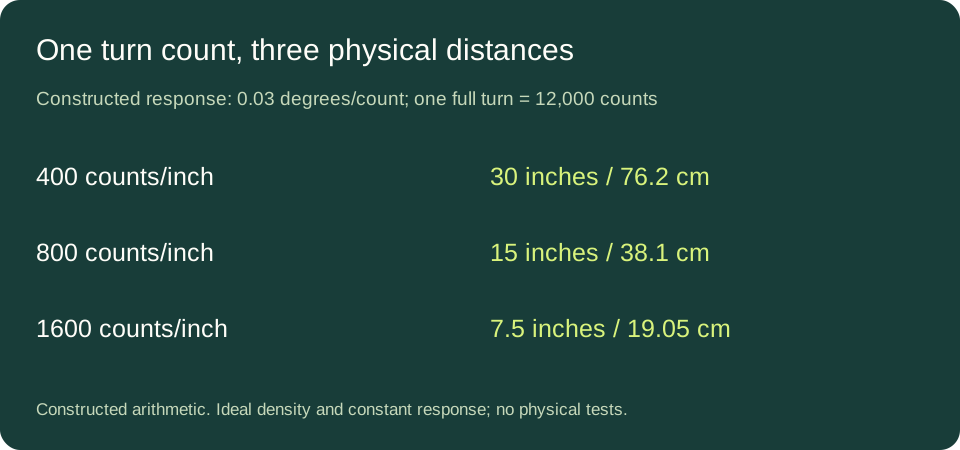
Choose a fictional q of 0.03 degrees per count. One full turn requires 360/0.03 = 12,000 counts. Half a turn requires 6,000 and a quarter turn requires 3,000. No sensor density appears in those equations. The selected coefficient is an arithmetic input for this guide, not a documented preset, a player preference or an observed hardware result.
Attach physical distance with an explicit density
Now assume C counts are delivered per inch of straight horizontal travel. The modeled physical distance for N counts is N/C inches, or 2.54 × N/C centimeters. With the same fictional 12,000-count turn, C = 400 gives thirty inches and 76.2 centimeters. C = 800 gives fifteen inches and 38.1 centimeters. C = 1600 gives seven and a half inches and 19.05 centimeters.
The count requirement remains unchanged across these three constructed rows because q stays fixed. The physical distance halves whenever the assumed density doubles. These are conditional calculations, not a recommendation to change DPI and not proof that a device delivers its nominal density on a particular surface. Keep a configured density and an independently measured density labelled separately in any real record.
Equal distance does not imply equal count totals
Reverse the question: require a modeled distance of 38.1 centimeters at density 1600. That distance is fifteen inches, so the count total is 15 × 1600 = 24,000. To make those counts produce exactly one full turn, q must be 360/24,000 = 0.015 degrees per count. This second constructed setup has the same physical full-turn distance as the 800-density row but twice its turn count.
Conversely, retaining 12,000 counts per turn while changing the assumed density cannot retain the same physical distance. The two comparisons preserve different quantities. A converter can match physical turn distance while the count-space response differs. That observation alone does not establish a difference in latency, smoothness, aim quality or on-screen pixel motion; none of those outcomes were measured here.
A movement report can contain several counts
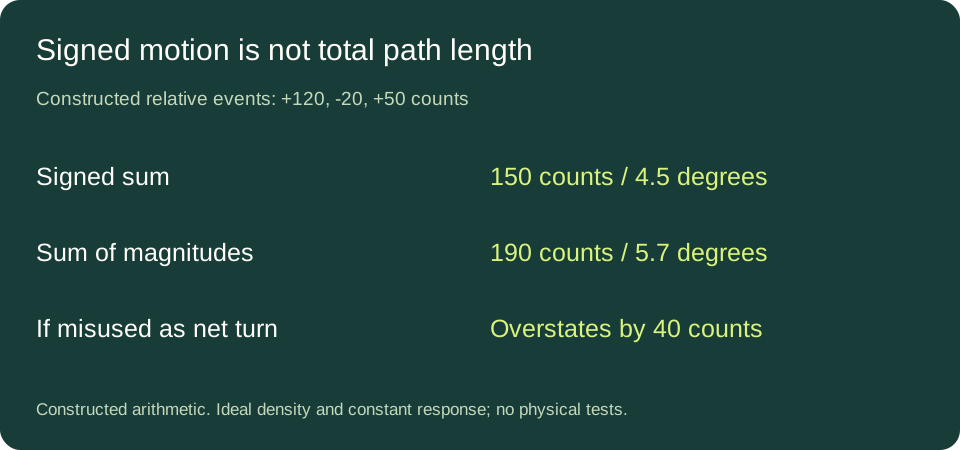
Invent three signed horizontal reports: +120, −20 and +50 counts. Their signed sum is 150. Multiplying by the fictional q gives a net rotation of 4.5 degrees. Counting the reports themselves gives three, which is neither the net count total nor the rotation angle. This counterexample shows why report count is not interchangeable with movement count even before timing is considered.
Adding magnitudes instead gives 120 + 20 + 50 = 190 counts. Multiplying that by q gives 5.7 degrees of modeled angular travel, including the reversal. It overstates the net rotation by 1.2 degrees, or forty counts. For a net-turn calculation keep direction; for total path length state that different purpose. Neither aggregation proves that a real application's records are complete.
Keep model identification separate from arithmetic
Suppose only a full-turn distance of 38.1 centimeters is known. At assumed density 800 it corresponds to 12,000 counts; at 1600 it corresponds to 24,000. The same distance therefore cannot determine the count total unless density is independently specified. Equally, a count total cannot determine physical travel by itself. Writing units beside every input exposes the missing information before a plausible-looking result is copied.
What to record for a real comparison
Record the game and build, aim mode, retained setting, input mode, configured device density, count aggregation rule and physical-distance procedure. Distinguish a prediction from an observation. Do not infer a game's current coefficient from this fictional example. For distance observations use the measurement record guide; for an unchanged setup use the separate distance-ratio adjustment.
Direct answers
Is a count one screen pixel?
Not by definition. Screen displacement needs a separate mapping; this guide models horizontal rotation, not a desktop pointer or a display projection.
Can I convert counts per turn to centimeters without DPI?
Only if equivalent count-density information is known. A count total alone leaves physical distance undetermined.
Does one input report equal one count?
No such assumption is used here. The synthetic report example contains movement values much larger than one.
Sources and method
Microsoft RAWMOUSE documentation defines relative and absolute movement fields. KovaaK's converter explanation supplies rotation and physical-distance context. All coefficients, densities and event sequences in the worked examples are author-selected; exact rational calculations and both diagrams were produced for this guide. No physical tests, performance results or universal game behavior are claimed.