MOUSE SENSITIVITY CONVERTER / DIAGONAL FOV GUIDE
Convert diagonal FOV without treating degrees as lengths
For a symmetric rectilinear view, diagonal FOV D and active aspect a = width/height give H = 2 × atan[tan(D/2) × a/√(a² + 1)] and V = 2 × atan[tan(D/2)/√(a² + 1)]. The rectangle's lengths obey Pythagoras; its full FOV angles do not. Diagonal FOV alone cannot identify both axis angles.
Published October 29, 2026 · AimConvert · an independent developer
Open the sensitivity converter ↗Define the diagonal before using a number
Here diagonal FOV means the angle between rays through opposite corners of a centered rectangular image plane. The construction assumes a symmetric rectilinear pinhole view and an active aspect ratio with square pixels. It does not describe every fisheye, asymmetric headset or cropped camera specification. Verify those assumptions before applying the equations to a real configuration.
Put the right triangle on the image plane
Call the image plane's half-width w, half-height h and distance from the pinhole f. The center-to-corner length is r = √(w² + h²). Dividing all three lengths by f gives tan(H/2) = w/f, tan(V/2) = h/f and tan(D/2) = r/f. Therefore tan²(D/2) = tan²(H/2) + tan²(V/2). This relation combines dimensionless tangent lengths rather than adding degree values.
To recover both axes from a diagonal angle, write a = w/h. Then w/r = a/√(a² + 1) and h/r = 1/√(a² + 1). Multiplying tan(D/2) by these two fractions gives the corresponding horizontal and vertical half-angle tangents. Applying inverse tangent and doubling produces the first answer. Use radians for trigonometric calculations, then convert the displayed angles to degrees.
One diagonal value does not fix the rectangle
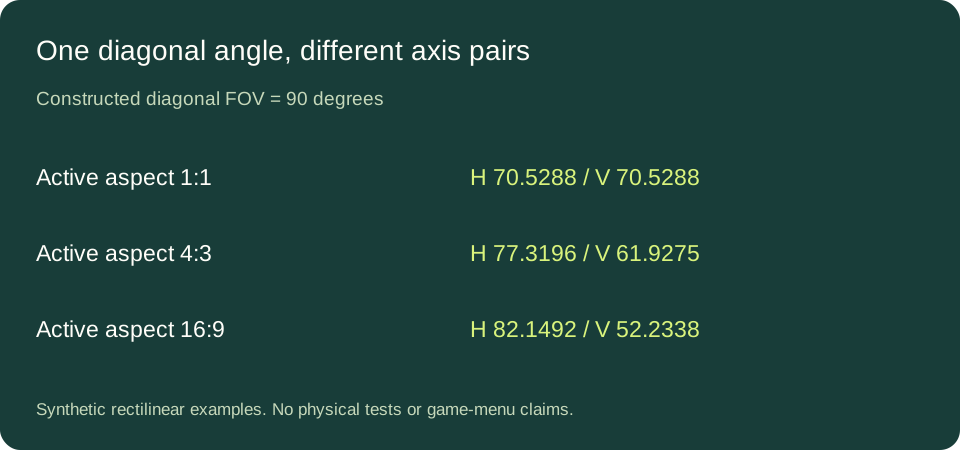
Choose a synthetic diagonal span of ninety degrees. A square active view gives equal horizontal and vertical spans of approximately 70.528779 degrees. At aspect four to three the pair becomes H = 77.319617 and V = 61.927513. At sixteen to nine it becomes H = 82.149220 and V = 52.233845. Each pair has the same constructed diagonal angle.
The wider rectangle allocates more of its fixed center-to-corner length horizontally and less vertically. This is a geometric allocation, not a claim that a game preserves diagonal FOV when its window changes shape. Without the active aspect, a single diagonal number leaves a family of possible axis pairs. It is insufficient to compare that number directly with another application's horizontal or vertical menu value.
Check the tempting degree-space shortcut
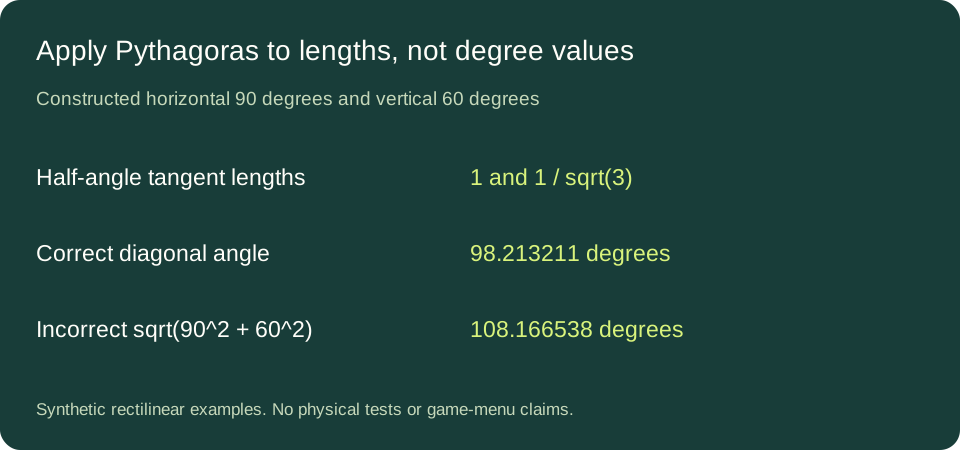
Now construct a view with H = ninety degrees and V = sixty degrees. Their half-angle tangents are one and one divided by the square root of three. The diagonal half-angle tangent is therefore √(1 + 1/3). Doubling its inverse tangent gives D = 98.213211 degrees after rounding. These selected axes imply their own rectangle; no game or device is associated with the example.
Applying √(90² + 60²) directly to the degree values instead gives 108.166538 degrees. It disagrees with the declared rectilinear construction because angular spans are not the perpendicular image-plane legs. The familiar triangle rule is still useful, but only after the projection maps half-angles to length ratios. The two computations are different operations, even though both return a plausible-looking angle.
Verify the conversion in both directions
For each synthetic axis pair in the table, recombine its unrounded half-angle tangents using the diagonal formula. The result returns ninety degrees within floating-point tolerance. The build calculation also repeats this check for diagonal inputs thirty, sixty, ninety and 120 degrees at all three aspects. These twelve round trips test the implemented arithmetic, not the validity of an unknown projection or product specification.
Two further checks follow from the rectangle. With positive width and height, the diagonal angle exceeds either axis angle while all remain below 180 degrees in this construction. Swapping width and height swaps H and V but leaves D unchanged. If a result violates these conditions, check units, the aspect definition and the equation before interpreting the output as a real view.
Keep projection conversion separate from mouse response
Diagonal, horizontal and vertical FOV are coverage descriptors. None supplies a mouse coefficient or a scoped response multiplier. A full-turn sensitivity match and a view-coverage comparison answer different questions. For two-axis conversion see the horizontal and vertical FOV guide; for image-coordinate behavior see angle per count versus projected pixels.
Direct answers
Is diagonal FOV the same as horizontal FOV?
No, under this rectangle model they describe different ray pairs. Label the axis and active aspect.
Can a diagonal value determine both axes without aspect?
No. The table supplies explicit different pairs for the same diagonal angle.
Does this convert any lens or headset specification?
No. The stated symmetric rectilinear assumptions must hold; this guide does not verify a product's projection or measurement convention.
Sources and method
Microsoft's perspective projection example provides half-angle tangent context. The diagonal derivation, selected counterexamples, numerical round trips and diagrams here were independently produced. All values are synthetic calculations, rounded to six decimal places where shown; no physical or game tests are reported.