MOUSE SENSITIVITY CONVERTER / SCALE GUIDE
Why the same eDPI differs across games
eDPI is DPI × sensitivity. It leaves out the game's yaw scale, so equal eDPI can produce different turn distances across games. To match modeled cm/360, match eDPI × yaw instead. Equal turn distance still does not guarantee identical visual feel.
Published October 18, 2026 · AimConvert · an independent developer
Use the yaw-aware converter ↗What information is missing from eDPI?
Within one unchanged sensitivity scale, eDPI is a compact way to record the DPI–sensitivity product. Across different scales, the same product is missing an important conversion factor. Yaw describes horizontal degrees of rotation per mouse count at sensitivity one in the linear model used here. A larger yaw gives more rotation for an otherwise identical input.
Always record the preset, axis and aiming mode alongside eDPI. A number without those labels does not identify a cross-game turn distance. This guide concerns modeled horizontal hipfire rotation; it does not cover separate scope multipliers, nonlinear input or screen-space matching.
Controlled test: hold eDPI equal
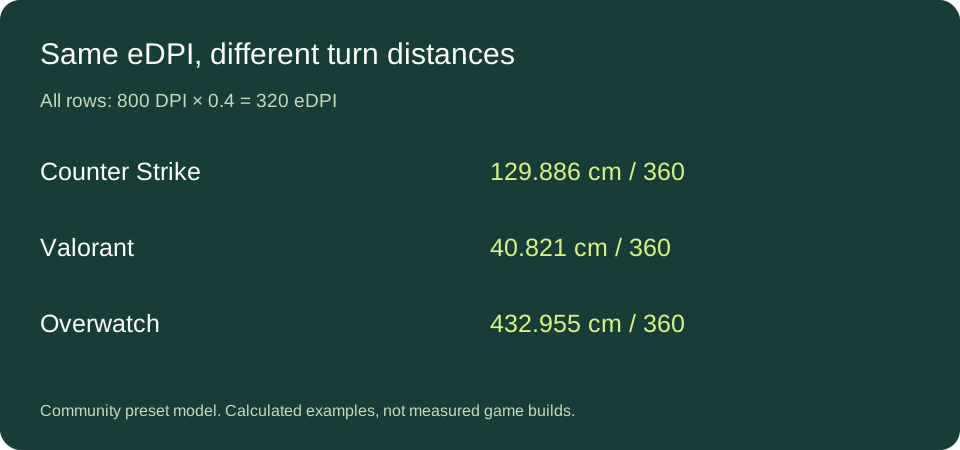
Set DPI to 800 and sensitivity to 0.4 for every row. The eDPI product is therefore 320 in every case. Change only the yaw coefficient, using the pinned community presets below. These are independently calculated examples, not measurements of current game builds. Older preset names are retained exactly; a preset named Overwatch does not establish support for a sequel.
Degrees per inch = eDPI × yaw
cm/360 = 360 × 2.54 ÷ (eDPI × yaw) = 914.4 ÷ (eDPI × yaw)
| Community preset | Yaw | eDPI | cm/360 |
|---|---|---|---|
| Counter Strike | .022 | 320 | 129.886364 |
| Valorant | .07 | 320 | 40.821429 |
| Overwatch | .0066 | 320 | 432.954545 |
For the Counter Strike row, 320 × 0.022 = 7.04 degrees per inch. Dividing 914.4 by 7.04 gives about 129.886364 centimeters for a full turn. The Valorant row instead gives 320 × 0.07 = 22.4 degrees per inch and about 40.821429 centimeters. Equal products have not produced equal distances because the remaining coefficient is different.
The Overwatch row uses 320 × 0.0066 = 2.112 degrees per inch, giving about 432.954545 centimeters per full turn. This deliberately long distance is a useful mathematical counterexample, not a suggested playable setting. Rejecting it because the chosen sensitivity looks unusual would hide the point of the controlled test: holding one number constant cannot compensate for a changing scale.
Reverse the test: hold distance equal
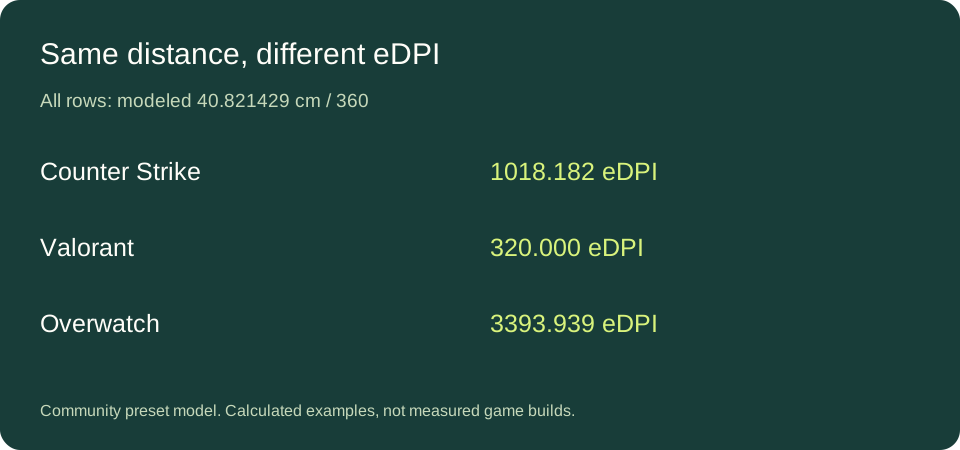
Now use the Valorant row's modeled distance as the target: 914.4/22.4, or approximately 40.821429 centimeters. To preserve that distance, the target eDPI multiplied by its yaw must equal 22.4. Solve for target eDPI, then divide by 800 to obtain the sensitivity for the same DPI. Do not force the eDPI values to remain equal.
Target sensitivity at 800 DPI = target eDPI ÷ 800
| Preset | Sens at 800 DPI | eDPI | cm/360 |
|---|---|---|---|
| Counter Strike | 1.272727273 | 1018.181818 | 40.821429 |
| Valorant | 0.400000000 | 320.000000 | 40.821429 |
| Overwatch | 4.242424242 | 3393.939394 | 40.821429 |
The Counter Strike row needs about 1018.181818 eDPI and sensitivity 1.272727273. Multiplying its unrounded eDPI by 0.022 gives 22.4. The Overwatch row needs about 3393.939394 eDPI and sensitivity 4.242424242; its unrounded product with 0.0066 also gives 22.4. The arithmetic checks the common distance before any game setting is applied.
The ratio gives an additional consistency check: 0.07/0.022 is about 3.181818. Thus the Counter Strike eDPI must be that many times the reference eDPI to offset its smaller yaw. For the other coefficient, 0.07/0.0066 is about 10.606061. These are coefficient ratios from the stated model, not performance differences or claims that either game feels that many times faster.
A DPI-independent check
Keep the matched Counter Strike eDPI fixed but raise the target DPI from 800 to 1600. Its sensitivity becomes about 0.636363636 instead of 1.272727273. The eDPI and its product with yaw stay unchanged, so the modeled distance stays unchanged too. This separates a DPI compensation question from a game-scale conversion question: changing the factorization of eDPI does not remove yaw from the equation.
Use the result with the right labels
In AimConvert, select the source and target presets, enter both DPI values, and read the calculated target sensitivity and cm/360. Treat source and target eDPI as labeled outputs rather than targets that must be equal. If a preset does not cover your game's current input scale or aim mode, this example does not validate it.
Apply the target value through supported settings and read back what the game retained. For a physical check, record repeated turn-distance observations under the same conditions. This article provides calculations only. See the rounding guide for stored decimal limits and the DPI compensation guide for changing DPI within one scale.
Direct answers
Can equal eDPI ever match across games?
Yes, if the relevant yaw and other multipliers also match in this linear model. Equal eDPI alone does not establish those conditions.
Does matching cm/360 promise identical aim feel?
No. It matches modeled full-turn distance, not every aspect of visual response, field of view or scoped input.
Should I copy another player's eDPI?
Only interpret it with the game scale and aim-mode context. The calculations here establish no best or recommended eDPI.
Sources and method
The coefficients come from pinned community preset data. All matrices and figures were independently calculated for this article using decimal arithmetic. CORSAIR's eDPI calculator FAQ also limits direct eDPI comparisons to the same game. No publisher-certified or current-build measurements are claimed.